
In this edition, as we look forward to the fall season, we also revisit the exciting activities of the first half of 2026! We hosted yet another successful annual delegation visit for our members from Japan and were joined by top policy experts, published our 2026 Data Release, launched our Annual Impact Report and an updated Employment Study, participated in a QS Global Skills Week panel on workforce development, joined the NAJAS Annual Summit in New Orleans, and welcomed a new staff member to the JAMA USA team.
We are also thrilled to share that this year, as America celebrates its 250-year birthday, JAMA USA is simultaneously celebrating its 50th Anniversary! To all of our friends and allies throughout the decades, thank you for your partnership and support as we toast to this significant milestone. On to another 50 years and beyond!
JAMA USA Office Highlights
2026 Annual Delegation
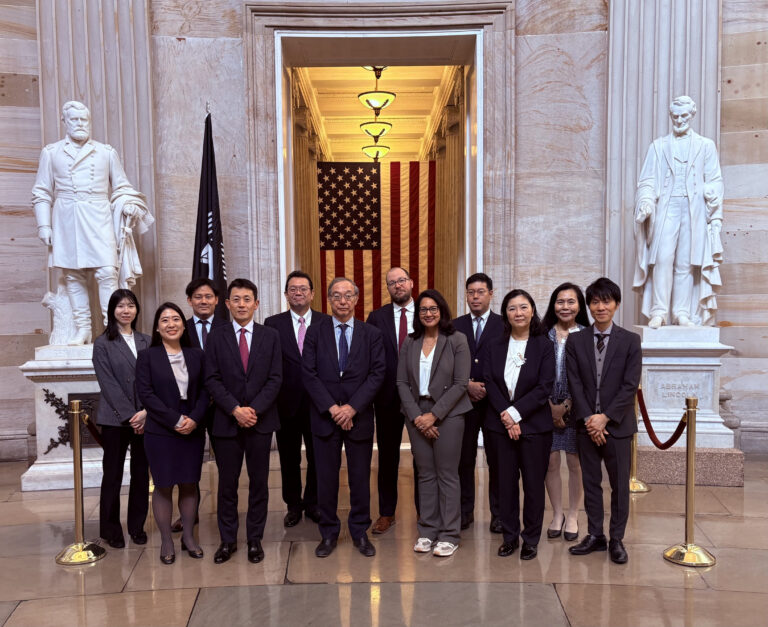
On March 3-4, JAMA USA hosted yet another meaningful delegation to Washington D.C. consisting of our members from Tokyo and colleagues from our members’ U.S. operations. Various policy and industry experts from the private sector, think tanks, and former government representatives, were invited to brief our delegation on a number of timely issues including an overview of the current political landscape, the state of the U.S. economy, the future of U.S. trade policy, U.S.-Japan economic cooperation, U.S.-China policy and supply chains, USMCA and the latest developments in the automotive industry.
As is the case annually, this was also an invaluable opportunity for JAMA to convene and plan strategically for the year ahead together with our members. The delegation also had the opportunity to enjoy a special private tour of the Capitol Building and the Senate Floor.
Annual Data Release
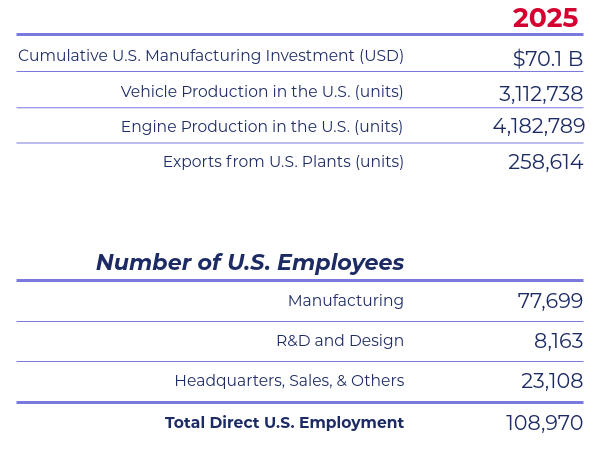
On March 18, ahead of Prime Minister Sanae Takaichi’s visit to the White House, which affirmed the strength and vitality of the U.S.-Japan relationship, JAMA USA published its annual data release. This highlights Japanese-brand automakers’ decades-long commitment to the U.S. economy through job creation, vehicle production, and overall cumulative investment. Reflecting this profound legacy, cumulative manufacturing investment in the U.S. has increased to a record $70.1 billion, and employment has grown to 108,970 direct jobs. JAMA members now operate 26 manufacturing plants, 41 R&D and design facilities and 65 distribution centers in communities across 27 states.
Japan continues to be the top provider of foreign direct investment (FDI) in the U.S. for the past seven years in a row, which only further underscores the robust economic ties between the two countries. This strong economic partnership is also reflected in communities across America, where our members have made longstanding investments and commitments that benefit American workers, communities, and consumers.
To view the official press release please see here.
JAMA Impact Report & Employment Study
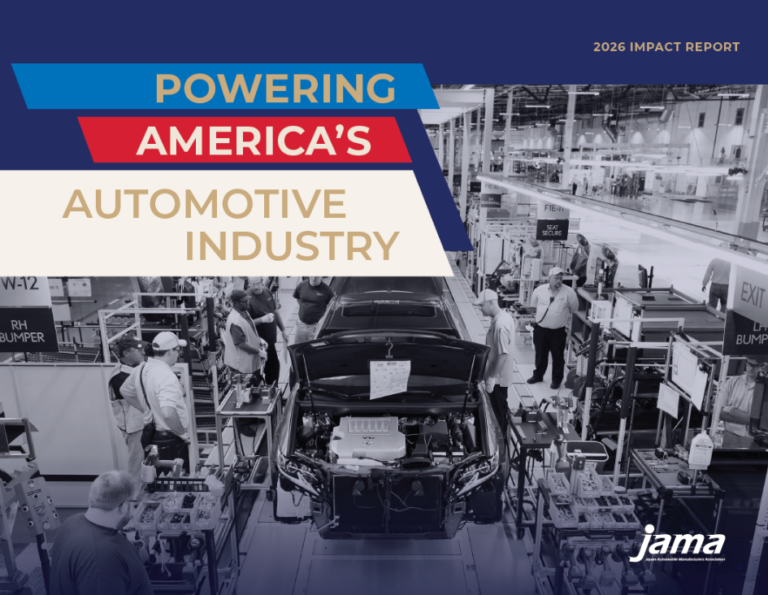
On May 4, JAMA USA jointly released its 2026 Annual Impact Report entitled, “Powering America’s Automotive Industry,” and an updated employment study, “The Impact of Japanese-brand Automakers on U.S. Employment.” The impact report is a follow-up to our annual data release published in March, which further substantiates Japanese-brand automakers’ long-standing, good-quality foreign direct investment (FDI) across the United States and reflects our members’ steadfast commitment to the American economy, automotive industry, workforce, and communities.
Our updated employment study authored by Dr. Thomas J. Prusa of Rutgers University quantifies the employment impact of Japanese-brand automakers’ U.S. investment. As of 2025, Japanese-brand automakers and their dealer networks have supported approximately 2.34 million U.S. jobs, including over 1 million direct, intermediate and spin-off jobs generated from these automakers, as well as an additional 1.28 million direct, intermediate and spin-off jobs generated through their dealer networks. Together, these jobs generate roughly $221 billion in labor compensation and $161 billion in disposable income for U.S. households, emphasizing our members’ broad economic impact in communities across America.
QS Global Skills Week Panel

On March 25, Anita Rajan, JAMA USA General Director, participated in the QS Quacquarelli Symonds Global Skills Week Conference in D.C. She had the opportunity to discuss how JAMA members’ good-quality FDI enable their U.S. organizations to build the talent pipelines advancing the U.S. automotive industry. In particular, Rajan highlighted the importance of early exposure to skills in elementary, middle and high schools that help lead to careers in manufacturing. Rajan also noted the growth and success of earn and learn programs like the Federation for Advanced Manufacturing Education (FAME) program.
The discussion was moderated by Clare Bertrand, M.S.Ed, Executive Director for Partnerships and Ecosystem Strategy, Policy & Advocacy at The College Board, and Rajan was joined by fellow panelists from the American Welding Society and the National Restaurant Association Educational Foundation (NRAEF).
2026 NAJAS Annual Meeting

In August, Jenny A. Kai, Senior Manager of Government and Public Affairs, participated in the 2026 NAJAS Summit in New Orleans, Louisiana. This annual gathering brings together the extensive national network of Japan America Societies (JAS), and high-level experts and professionals committed to further strengthening the bilateral relationship. The beignet and jazz-filled summit included dynamic discussions between attendees and experts on a variety of topics including U.S.-Japan relations within the context of global/regional security, energy and economic security, and the importance of grassroots efforts in sustaining one of the most consequential bilateral relationships in the world.
JAMA members in numerous states across the country, especially where they have robust manufacturing footprints, often have close ties with their local JAS chapters. By supporting and collaborating with the grassroots activities of these organizations from the ground up, a powerful and virtuous cycle is formed between our members and these local organizations. It was particularly inspiring to hear from various NAJAS network representatives just how much Japanese-brand automakers have helped to fundamentally transform the economic livelihoods of countless communities across America and, together with local JAS chapters, have helped instill a deep curiosity and passion for Japan in the U.S.
JAMA USA Welcomes New Staff: Tatsuru Irinamihira

In April, we were delighted to welcome our new Deputy General Director, Tatsuru (Nami) Irinamihira to our office. He helps oversee the U.S. branch office’s operations and provides analysis on various policy and economic developments. He is also the liaison between JAMA USA and JAMA headquarters in Tokyo.
Nami-san joined JAMA headquarters in Tokyo in 2002 and began his career in research and statistics, focusing on the analysis and forecasting of overseas automotive markets. Since then, he has held a range of positions covering international policy affairs, regional engagement, and organizational management. He has previously served as the Deputy General Director for JAMA’s now closed Singapore Office where he oversaw trade and public relations issues and supported regional engagement efforts.
Please join us in welcoming Nami-san to Washington D.C.!
Public Comments
JAMA Comments on the Section 301 Investigation on Excess Capacity

On April 15, JAMA submitted comments to the United States Trade Representative (USTR) in response to the March 17, 2026, request for comments relating to the Section 301 Investigation of Acts, Policies, and Practices of Certain Economies Relating to Structural Excess Capacity and Production in Manufacturing Sectors.
Overall, JAMA emphasized Japanese-brand automakers’ significant and steady expansion of their domestic footprint in the U.S. This is reflected in the record investment and job creation spanning vehicle, engine, transmission, parts, and battery production. In fact, approximately 75% of all vehicles JAMA members sell in the U.S. are built in North America, including roughly half produced in the U.S. This level of investment has also grown significantly in recent years – within the past 10 years, Japanese-brand automakers have invested $28 billion into new U.S. manufacturing initiatives.
However, in order to sustain this growing level of investment in the U.S., JAMA strongly urges the Administration to uphold the United States – Japan Trade Agreement, including the commitment that the 15 percent Section 232 tariff on automobiles and automobile parts be inclusive of MFN rates as well as ensuring that additional tariffs are not stacked upon them. JAMA also requests that Japanese-brand automakers’ substantial and growing domestic manufacturing presence is fully reflected when developing and implementing any future trade policies affecting the automotive sector.
To read JAMA’s comments, click here.
Member Spotlights
Toyota Announces Expansion of its San Antonio Plant
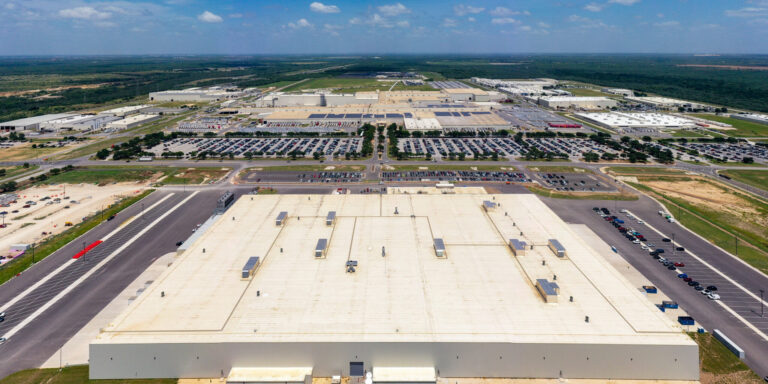
On July 6, Toyota Motor North America (TMNA) announced a substantial $3.6 billion expansion of its manufacturing plant in San Antonio, Texas. This investment will add a second vehicle assembly line to support the production of the Tacoma truck. As part of this growing investment, there will be 2,000 new high-quality jobs and an expansion of the plant by 2.5 million square feet. This will effectively double the size of the manufacturing facility by 2030. The latest expansion will bring Toyota’s total investment in San Antonio to $8.3 billion since first breaking ground in 2003.
Subaru Announces Production of Hybrid Vehicles

On February 3, Subaru of Indiana Automotive (SIA) announced that it would begin production of its 2026 Forester Hybrid in its Lafayette, Indiana, manufacturing facility. This is the first hybrid vehicle to be produced by Subaru in the U.S., which is the culmination of five years of planning. Now, all Subaru Forester models sold in the U.S. are assembled at SIA. Since starting production in Indiana, in 1989, SIA has assembled more than 6 million Subaru vehicles.